Car Window Tinting: What to Know Before You Tint
Senior Automotive Glass Diagnostic Specialist & Master Technician at CarGlassFix · AGSC Master Certified Auto Glass Technician, NGA Certified Installer, I-CAR Automotive Safety Specialist · 12+ Years in Automotive Glazing, Windshield Structural Bonding, ADAS Camera Calibration & Precision Chip Restoration
Car window tinting is a thin polyester film applied to the inside of a car’s windows to cut visible light, heat and UV. Factory privacy glass is different: its color is made into the glass. Before tinting, check your state’s limit, then choose the film type, shade, installer and warranty, and let the film cure.
What is car window tinting?
Car window tinting is the application of a thin film to the inside surface of a car’s windows to reduce the light, heat and UV that pass through. The IWFA, the window film trade group, says almost all window films go on the interior side of the glass.
The film is a polyester sheet with a scratch-resistant coat on one face and a pressure-sensitive adhesive on the other. A color layer, carbon, metal or ceramic particles inside the film decide how much light it absorbs or reflects. Our explainer on how car window tint works covers the layers and the physics.
Three numbers describe any film. VLT (visible light transmission) is the share of visible light that gets through, so a lower number means a darker film. TSER (total solar energy rejected) is the share of the sun’s total energy the film keeps out. UV rejection is the share of ultraviolet blocked.
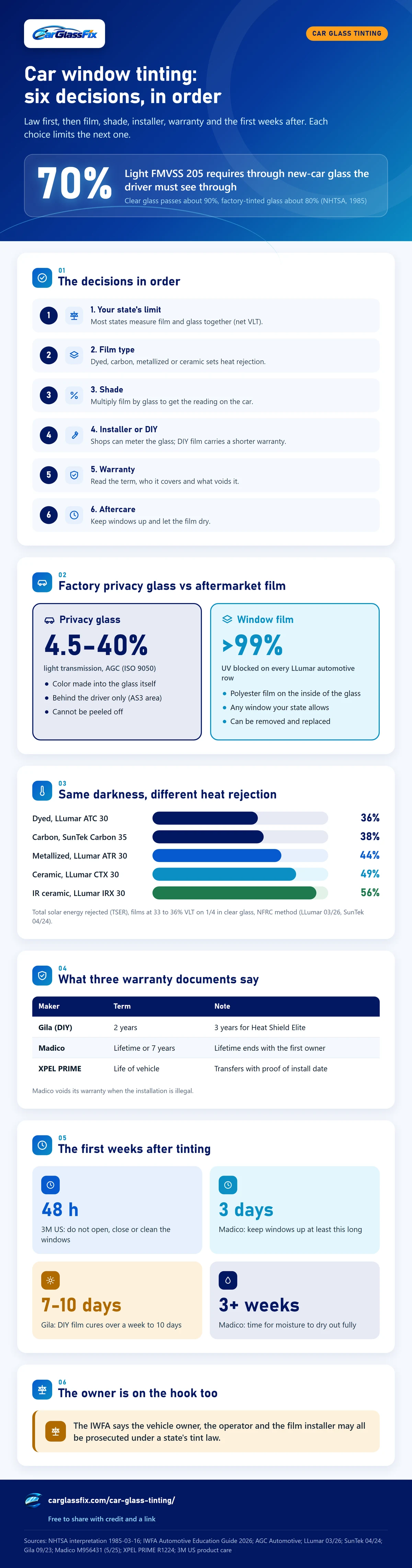
Tinting is a set of decisions in a fixed order. The law limits the shade. The shade and the film type set the heat result. The installer and the warranty decide what happens if the film fails. Aftercare decides whether it cures cleanly. Each section below gives the short answer and hands off to the page that covers that decision in full.
Factory privacy glass vs aftermarket film
Factory privacy glass is glass with the dark color made into it at the plant, while aftermarket film is a separate layer stuck to the inside of the glass. AGC, a glass maker, says its privacy glass gets its dark tint by altering the chemical composition of the glass.
All car glass is tinted to some degree. The IWFA says the color is mixed into the glass during manufacture. NHTSA wrote in 1985 that clear windows pass about 90% of light and factory-tinted windows about 80%. AGC lists its privacy glass at 4.5% to 40% light transmission, against more than 70% for normal vision glass. GM describes its privacy glass as nominally 20%.
Federal rules explain where the dark glass goes. FMVSS 205 requires at least 70% light transmission in glass needed for driving visibility. The IWFA says the windows behind the front seats on trucks and multipurpose vehicles fall outside that requirement, which is why SUVs and pickups can leave the factory with dark rear glass.
Sources disagree on UV. AGC lists UV transmission of 0.2% to 7% for its privacy glass, against 20% to 38% for vision glass. The IWFA says tinted glass does not normally have added UV protection. Our page on what privacy glass is on a car sets out both claims.
| Feature | Factory privacy glass | Aftermarket film |
|---|---|---|
| Where the color is | In the glass itself | In a polyester film on the inside |
| Typical windows | Behind the driver on SUVs, vans and pickups | Any window the state allows |
| Light transmission | 4.5% to 40% (AGC); nominally 20% (GM) | Set by the film shade, multiplied by the glass |
| UV | 0.2% to 7% transmitted (AGC); no added UV protection (IWFA) | More than 99% blocked on LLumar’s automotive sheet |
| Removal | Cannot be removed | Can be removed and replaced |
Step 1: Check your state’s tint law
Your state’s tint law sets the darkest shade you can legally put on each window, so it is the first thing to check. Limits differ by window: the windshield, the front side windows, the back side windows and the rear window.
How states measure tint
Most states measure film and glass together. The IWFA calls this a net VLT requirement, because film is almost impossible to measure on its own once it is installed. Film makers rate their films on clear glass. On factory-tinted glass the reading on the car is lower than the number on the box. The IWFA says meter tolerances average about 5% and range from 3% to 7%, and some states allow no tolerance.
Who is responsible
The owner is responsible as well as the shop. The IWFA says the vehicle owner, the operator and the film installer may all be prosecuted under a state’s tint law. Some states also limit how reflective a film may be. Florida, for example, caps front side reflectance at 25% under Fla. Stat. 316.2953.
How far apart the limits are
The range is wide. California requires any material on the front side windows to pass at least 88% of light under Cal. Veh. Code 26708. Florida allows 28% on the front side windows. Our statute-based table of window tint laws by state counts 35% as the most common front side limit, used by 19 states. Michigan, New Jersey and Vermont allow no film on the front side windows. Laws change, so confirm the current limit with your state’s statute or police before you book. This is general information, not legal advice.
Step 2: Choose a film type
The film type decides how much heat a film rejects at a given darkness, so two films of the same shade can perform very differently. The IWFA groups automotive films into clear, nanoceramic, reflective metallized and sputtered films, plus entry-level colored (dyed) films. Film makers also sell carbon films.
Spec sheets show the gap. The table lists films near one-third VLT, tested by the NFRC method on 1/4 in clear glass. Every row blocks more than 99% of UV.
| Film (maker’s label) | Type | VLT | TSER |
|---|---|---|---|
| LLumar ATC 30 | Color-stable dyed | 33% | 36% |
| SunTek Carbon 35 | Carbon | 36% | 38% |
| LLumar ATR 30 | Metallized | 34% | 44% |
| LLumar CTX 30 | Ceramic | 34% | 49% |
| LLumar IRX 30 | IR-rejecting ceramic | 33% | 56% |
Metal in a film can matter for electronics. The IWFA says films with high electrical conductivity can interfere with antennas built into the glass and advises a non-metallic film in that case. It adds that some dealerships and carmakers may void the warranty on certain electronics if conductive film is installed. Our ceramic vs carbon tint comparison lines up the two most common non-metal choices.
Step 3: Choose a shade
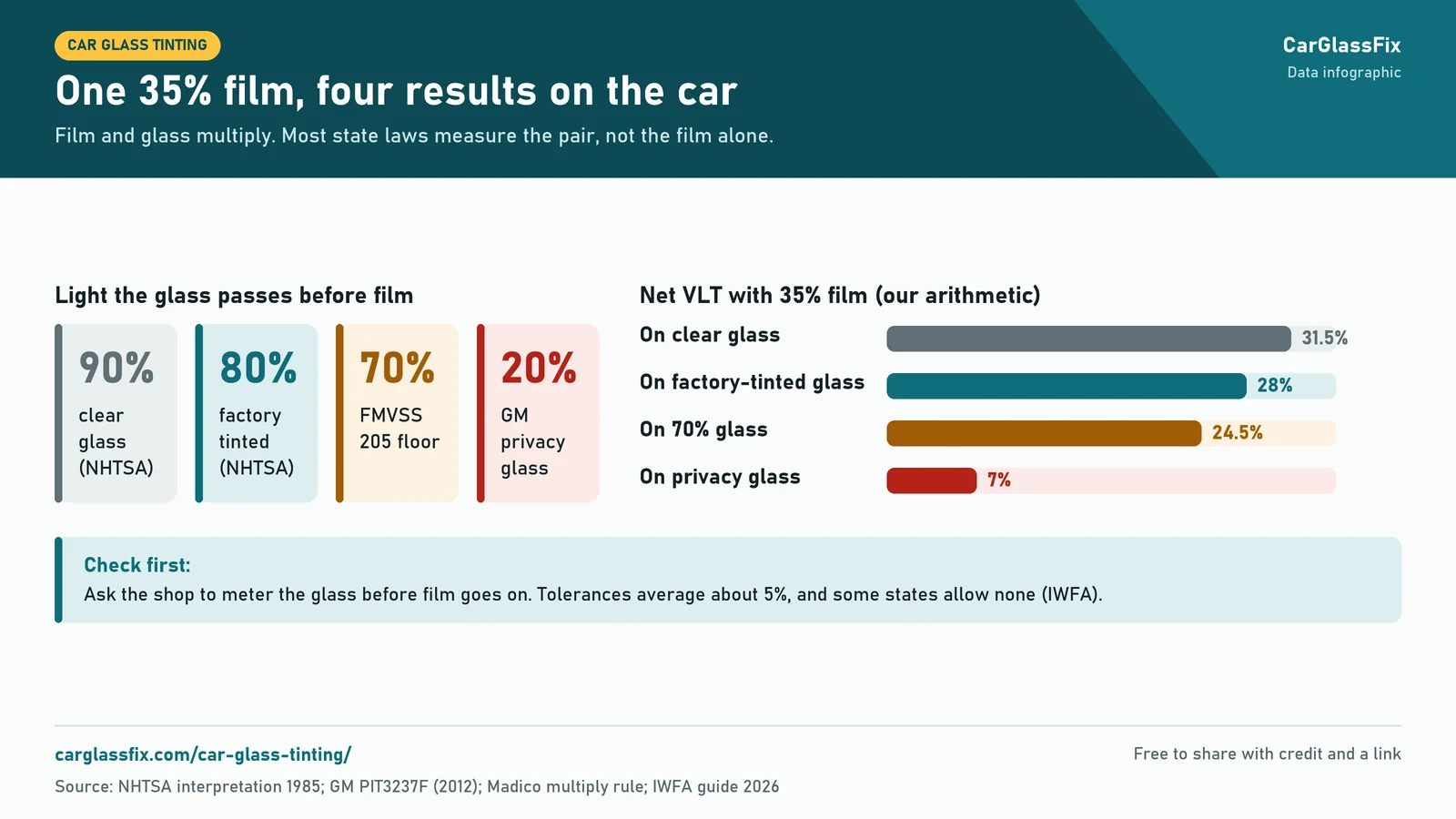
Choose the shade by working out what the film will read on your car’s glass, not by the number on the film alone. Madico, a film maker, says to multiply the two values: 70% glass with a 50% film gives 35%.
The diagram above shows the effect. A 35% film reads about 31.5% on clear glass and about 28% on 80% factory-tinted glass, by our arithmetic. On 20% privacy glass the same film reads about 7%. A shop with a meter can read the bare glass first. The IWFA says shops should have hand-held meters to check the film and glass together when in doubt.
The outside view and the inside view differ. A 2012 study sent to Virginia lawmakers by the Virginia State Police explains that light seen by someone looking into a car drops to about the square of the VLT. A 35% window therefore returns about 12.25% of the light to an outside viewer, while the driver looks out through 35%.
Darker shades cost some night vision. LaMotte and colleagues (Human Factors, 2000) found that a 37% window did not significantly reduce contrast sensitivity for younger drivers, while an 18% window did. For older drivers, 37% already reduced it significantly. Our window tint percentage chart shows each shade from 5% to 90%.
Step 4: Pick a professional installer or do it yourself
A professional installer suits most drivers because a shop can meter the glass, the film maker’s warranty is issued through the dealer, and Madico makes the dealer responsible for the installation. You can install DIY film yourself, but the same state limit applies to it.
What the DIY instructions require
Gila, a DIY film brand from Eastman, says to apply its film below 100°F and only when temperatures will stay above 40°F for at least three days. Gila says installation is easier with two people. Gila warrants its films against manufacturing defects for two years, or three years for Heat Shield Elite. That warranty covers the product, not your workmanship. Our guide on how to install car window tint gives the full maker steps.
What to ask a shop
Ask for the film brand, the exact product line and the shade for each window in writing. Ask the shop to meter your glass and state the expected net reading. Ask for the maker’s warranty card. Madico’s card asks for the installation date and a roll serial number for each product, and says to keep it with the original receipt. The IWFA also notes that stickers on the glass give a poorer bond, and that some laminated door glass needs a film the glass maker approves.
What it costs
Price depends on the film line, the number of windows and the vehicle. Current ranges are on our page on how much car window tint costs.
Step 5: Read the warranty before you pay
Read the warranty for the exact film line before you pay, because the term, who it covers and what voids it differ by maker and by product. The type of film alone does not set the term.
Madico’s US warranty card shows the spread inside one brand. Its limited lifetime warranty lasts for the lifetime of vehicle ownership by the original film purchaser. Its Charcoal and GP Max films carry a 7-year term instead. The card says an illegal installation voids the warranty, and it does not cover mechanical damage such as scratches.
XPEL’s PRIME warranty runs for the life of the vehicle from installation. It transfers to a new owner who sends proof of the original installation date, for the rest of the term. XPEL excludes damage from automatic car washes and improper wash tools.
Ask the shop whether the warranty comes from the film maker or only from the shop. Ask whether it covers labor as well as film, and whether it transfers if you sell the car. Our page on how long car window tint lasts compares warranty terms across more makers.
Step 6: Care for the film after tinting
After tinting, keep the windows up and leave the film alone while the water under it dries out. Makers give different waits, so follow the card from your own installer.
3M US says not to open, close or clean the windows for at least 48 hours. IDS says at least 2 days. Madico says not to roll the windows down for at least 3 days. Gila says its DIY film cures over a week to 10 days, faster in dry, sunny weather and slower in wet, cold weather. Madico says it can take 3 weeks or longer for bubbles and moisture to dry out.
Some haze and small water pockets are normal during this time. Madico says not to pierce a water bubble during curing, because that damage is not covered by the warranty. Cleaning advice also differs. Madico allows household glass cleaner or soapy water. IDS says not to use ammonia-based cleaners.
The steps below put the first weeks in order. Our full guide on what to do after tinting car windows covers each wait and when to call the installer.
How to care for new car window tint
Keep the windows up
Leave them closed for the time on your warranty card: 48 hours (3M US), 2 days (IDS) or 3 days (Madico).
Leave water pockets alone
Haze and small bubbles dry out on their own; Madico says it can take 3 weeks or longer.
Wait before cleaning the inside glass
Gila says at least 3 days for its film; follow your own card.
Clean gently
Use a soft, clean cloth and no abrasives; skip ammonia if your maker says so.
Keep the paperwork
Store the warranty card and receipt in case the film fails later.
Frequently asked questions
Is factory tint the same as window film?
No. Factory tint is color made into the glass during manufacture, while window film is a separate polyester layer stuck to the inside of the glass. Film can be removed, and factory color cannot.
Can you put tint film over factory privacy glass?
Yes, where your state allows it, but the two values multiply. A 35% film on 20% privacy glass reads about 7%, by our arithmetic, so check your state’s net limit for those windows first.
Does all window tint block UV?
Every automotive film on LLumar’s 03/26 spec sheet lists more than 99% UV rejection, from near-clear to the darkest shade. Darkness and UV blocking are separate properties.
Who gets the ticket if my tint is too dark?
The IWFA says the vehicle owner, the operator and the film installer may all be prosecuted under a state’s tint law. Fines and fix-it rules vary by state.
How long should I wait to roll down the windows after tinting?
Makers say 48 hours (3M US) to at least 3 days (Madico). Use the wait on your own warranty card, and allow longer in cold or wet weather.
Sources
- IWFA, Automotive Education Guide 2026, pp. 19, 29, 32, 38-41, checked 2026-11-06
- NHTSA interpretation 1985-03.16 (FMVSS 205 light transmittance), checked 2026-10-31
- AGC Automotive, Privacy Glass, checked 2026-11-06
- GM Preliminary Information PIT3237F (October 2012)
- Madico, Mastering Tint Percentage Guide
- California Vehicle Code 26708, checked 2026-10-24
- Florida Statutes 316.2953 (2025), checked 2026-10-24
- LLumar Window Film Performance Data, LL0116NAEN (03/26)
- SunTek Automotive Window Film Specifications (04/24)
- Virginia State Police, RD375: Safety and Visibility Issues Associated with Motor Vehicle Window Transmittance (2012)
- LaMotte et al., Window tint and contrast sensitivity, Human Factors 42(2), 2000
- Gila, Side roll-down windows installation instructions (09/23)
- Madico Automotive Window Film Limited Warranty, M956431 (5/25)
- XPEL PRIME Window Film Limited Warranty (R1224)
- IDS Automotive Window Tint Warranty Card
- 3M US, Product Care

Similar Posts