Can You Get Sunburn Through Car Windows? UV Data by Glass
Senior Automotive Glass Diagnostic Specialist & Master Technician at CarGlassFix · AGSC Master Certified Auto Glass Technician, NGA Certified Installer, I-CAR Automotive Safety Specialist · 12+ Years in Automotive Glazing, Windshield Structural Bonding, ADAS Camera Calibration & Precision Chip Restoration
A sunburn through closed car windows is unlikely but not impossible. Car glass blocks almost all UVB, the band behind most sunburn. Windshields also blocked 96% to 99% of UVA in two US studies. Driver side windows blocked only 71% to 89%, so UVA still reaches skin and adds to long-term damage.
Can you get sunburn through car windows?
A sunburn through closed car windows is unlikely for most people, though published sources do not fully agree. The World Health Organization (WHO) says UVB is responsible for burning. Glass stops nearly all of that band. Hampton and colleagues wrote in the British Journal of Dermatology that window glass blocks all UVB but not all UVA.
UVA can still add to a burn at high doses. Cancer Council Australia states that UVA can cause sunburn. A 2023 study in Frontiers in Medicine concluded that UVB is more erythemogenic than UVA, meaning it reddens skin more readily. The guideline body ICNIRP gives 300 nm UVB a weight of 0.30 and 360 nm UVA a weight of 0.00013 in its skin and eye exposure limits. That is a gap of about 2,300 times per unit of energy.
One source is more cautious. Theresa Larkin of the University of Wollongong wrote in The Conversation that a person in a car without tinted windows “could burn after one hour” at midday in summer. That line was written for Australian readers. None of the measurement studies below tested a real burn on a person, so the fair reading is low risk with some uncertainty.
UVA vs UVB through the windshield and side windows
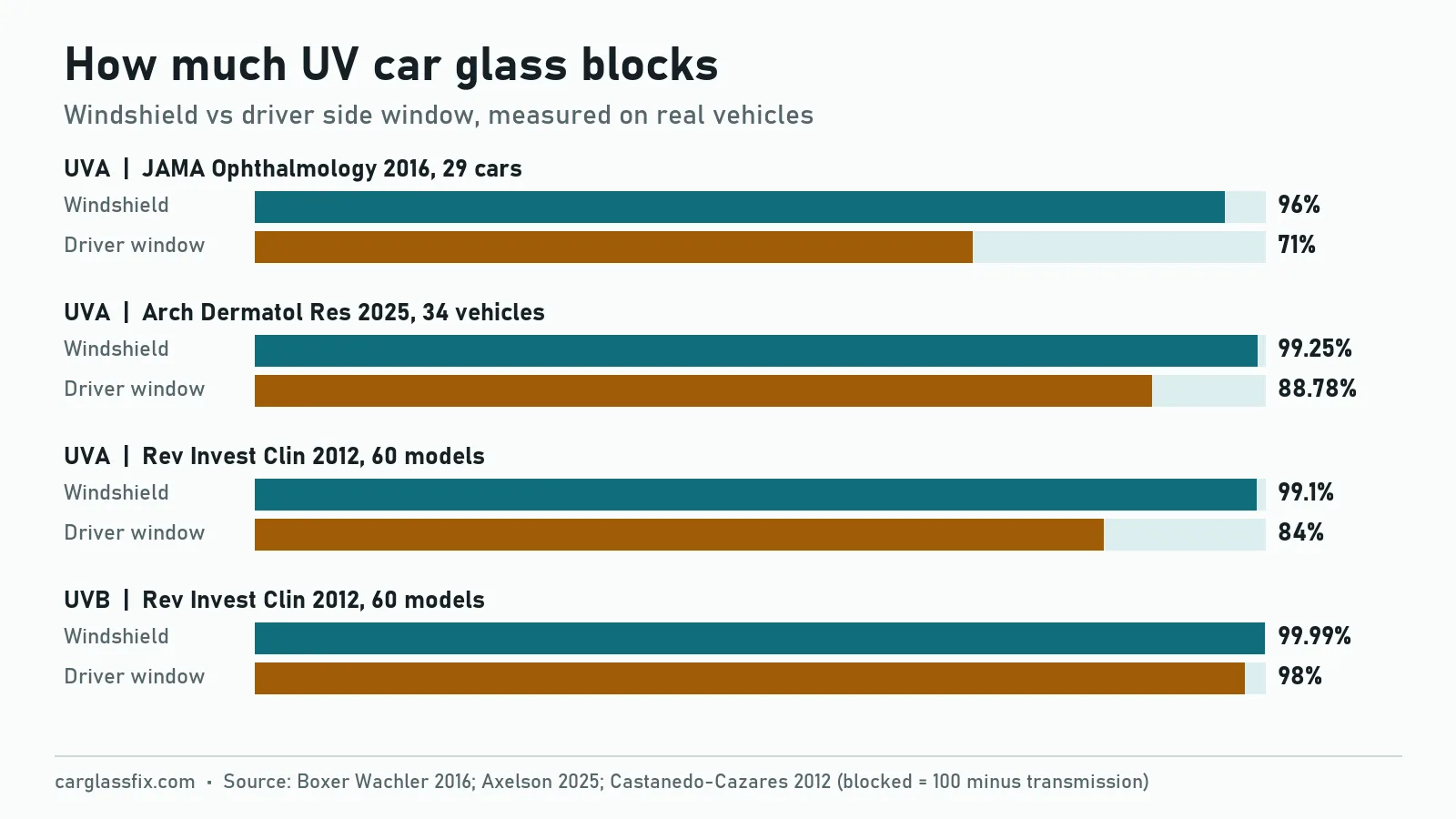
Windshields block far more UVA than side windows, and both block nearly all UVB. Three field studies measured this with meters on real vehicles, and each one found the same pattern.
| Study | Vehicles | Windshield UVA blocked | Driver window UVA blocked | UVB result |
|---|---|---|---|---|
| Boxer Wachler, JAMA Ophthalmology 2016 | 29 cars, 1990 to 2014, Los Angeles | 96% | 71% (range 44% to 96%) | Not measured |
| Axelson, Archives of Dermatological Research 2025 | 34 vehicles, 2015 to 2025, Philadelphia and New York | 99.25% | 88.78% | 100% except one window |
| Castanedo-Cazares, Revista de Investigacion Clinica 2012 | 60 models, 1998 to 2011, Mexico | 99.1% | 84% | Windshield 99.99%, side 98% |
The Axelson UVB exception was the rear left window of a 2024 Honda CR-V, at 37.5%. The authors rechecked it and still called it an outlier. Meters, sites and years differ, so the three studies should be read side by side and never averaged. The reason for the gap is construction. A windshield is laminated, while side and rear windows are usually tempered, as explained in what type of glass is used in car windows.
How much UV does car glass block?
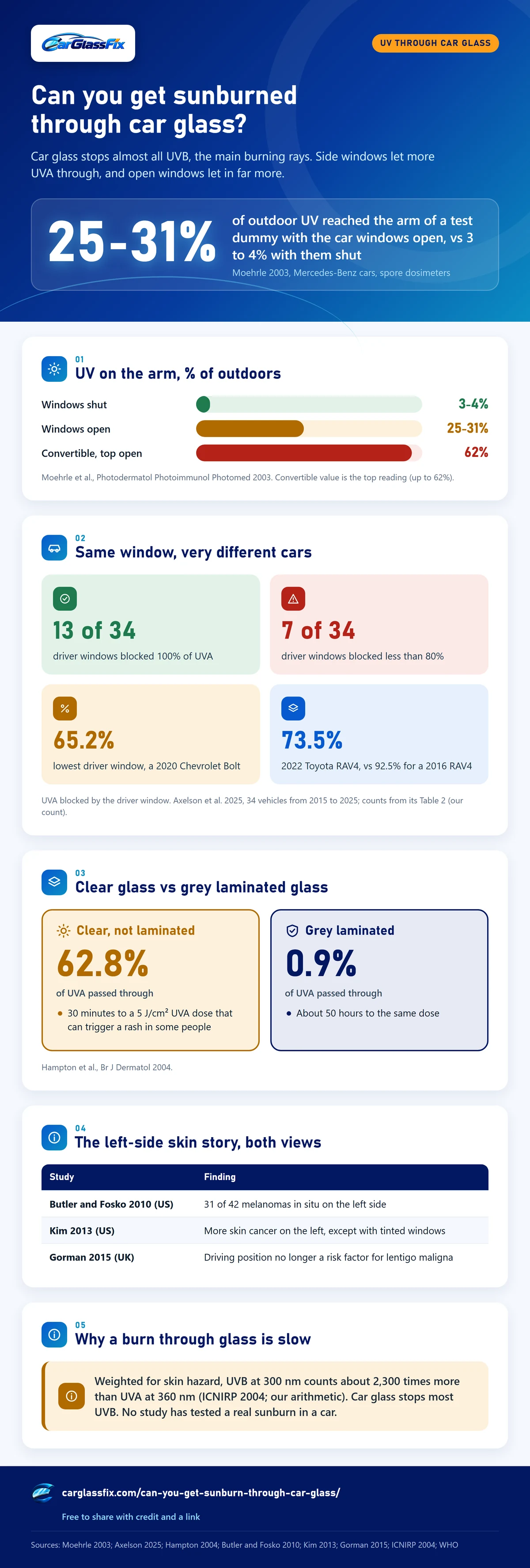
Car glass blocks almost all UVB and a variable share of UVA, so a single “95%” figure hides the real spread. The driver window results in the Axelson table show that spread clearly. Of 34 vehicles, 13 read 100% UVA blocked at the driver window and 7 read below 80%. The lowest was a 2020 Chevrolet Bolt at 65.22%.
Model name did not settle it. A 2022 Toyota RAV4 read 73.53% at the driver window, while a 2016 RAV4 read 92.5%. A 2021 Ford Mustang Mach-E read 100%, and a 2024 Mach-E read 83.33%. Luxury vehicles averaged 94.68% at the driver window and non-luxury vehicles averaged 87.25%.
Glass alone shows a wider range. Hampton measured 62.8% of UVA passing clear nonlaminated glass and 0.9% passing grey laminated glass. General Motors, in a 2012 bulletin, listed windshield UV transmission of 4% or less and front door glass of 35% or less. Eastman says conventional Saflex PVB interlayers screen 99% of UV up to 380 nm, and WHO runs UVA to 400 nm. The study-by-study case for laminated doors is on does laminated glass block UV rays. Some cars do have it, as listed on which cars have laminated glass.
When sunburn in a car becomes more likely
Open glass is the biggest change, because it removes the barrier that stops UVB. Moehrle and colleagues at the University of Tuebingen put UV dosimeters on dummies in Mercedes-Benz cars. The table shows arm exposure as a share of outdoor UV, plus our own arithmetic for one hour in the car.
| Setup | UV dose vs outdoors | One hour equals about |
|---|---|---|
| Windows shut (arm) | 3% to 4% | 2 minutes outdoors |
| Windows open (arm) | 25% to 31% | 15 to 19 minutes outdoors |
| Open convertible (highest dose) | 62% | 37 minutes outdoors |
Those figures come from one 2003 study of German cars, so treat the minutes as a scale and never as a safe limit. Photosensitivity is the other exception. The US Food and Drug Administration (FDA) says some medicines can cause sunburn-like symptoms, a rash or other side effects after UV exposure. Its list includes antibiotics such as doxycycline, plus some antihistamines and diuretics. Hampton calculated that 5 J/cm2 of UVA, enough to trigger polymorphic light eruption in some patients, could pass clear nonlaminated glass in 30 minutes. It would take 50 hours through grey laminated glass. Anyone taking such a medicine or living with a light-sensitive condition should ask their doctor or pharmacist about time in the car.
Long-term skin effects on the driver’s side
Studies link driving with more sun damage on the window side, but the cause is not settled. Butler and Fosko reviewed patients at a US skin cancer surgery unit. They found 52.6% of skin cancers on the left and 47.4% on the right. Melanoma in situ was far more lopsided, at 74% left and 26% right. Those patients were referred to an academic center, which limits the result.
Kim and colleagues surveyed patients at a Mohs surgery clinic. They found a left-sided excess of nonmelanoma skin cancers, except among people using cars with tinted windows. Sunscreen use was far lower in the car than in daily life. Boxer Wachler proposed that weak side-window UVA may partly explain left-sided skin cancer.
A 2015 UK review points the other way. Gorman and colleagues found a left-sided excess of lentigo maligna in a country where drivers sit on the right. They concluded that driving position no longer looks like a risk factor for that cancer, and they credited better window protection. The Skin Cancer Foundation still warns that UVA through window glass adds risk of premature aging and skin cancer on long sunny drives.
Tint and UV film for side windows
Clear UV film and some tints close most of the side-window gap, and darkness alone is a poor guide. The Skin Cancer Foundation says clear film can block 99% of UV. It also says a darker tint is no better for UV than a clear UV film. Castanedo-Cazares measured four commercial tinted films at under 4.5% UVA transmission and almost 0% UVB. The same authors called the added benefit marginal for most light-sensitive conditions, because closed windows already cut 98% of UVB and 84% of UVA.
Those two views fit together. Film matters most on glass in the lower Axelson readings, and it matters less on a door that already reads near 100%. Film types are covered on do car tinted windows block UV, and heat is a separate rating covered on does car window tint help with heat. To see whether a door is laminated or tempered, read the glass label using how to check a laminated windshield.
Frequently asked questions
Can you get sunburn through a windshield?
A windshield sunburn is very unlikely. Measured windshields blocked 96% to 99.25% of UVA in two US studies, and 99.99% of UVB in a study from Mexico. The laminated build is explained on laminated glass vs tempered glass.
Can you get a tan through a car window?
Some darkening is possible, because UVA passes side glass. The authors of a 2023 Frontiers in Medicine study say UVA primarily induces immediate and persistent pigment darkening. No study cited here measured tanning inside a car.
Can you get sunburned through tinted car windows?
The risk is lower still with a UV-rated film. Four tinted films in a Mexican study passed under 4.5% of UVA and almost no UVB. Tint darkness alone does not tell you the UV rating.
Do you need sunscreen in the car?
No health body cited here sets a car-specific rule. The American Academy of Dermatology recommends broad-spectrum sunscreen of SPF 30 or higher on skin not covered by clothing, and the Skin Cancer Foundation warns about UVA on long sunny drives. Your own skin and any medicines are a question for your doctor.
Do clouds change UV through car glass?
Clouds do not remove UV. The American Academy of Dermatology says up to 80% of the sun’s harmful UV rays can penetrate clouds. No study cited here measured car glass under cloud.
Sources
- Boxer Wachler BS, JAMA Ophthalmology 2016;134(7):772-5
- Axelson GE et al., Archives of Dermatological Research 2025;317:294 (full text PMC11742901)
- Castanedo-Cazares JP et al., Revista de Investigacion Clinica 2012;64:620-4
- Hampton PJ et al., British Journal of Dermatology 2004;151:873-6
- Moehrle M et al., Photodermatology, Photoimmunology and Photomedicine 2003;19:175-81
- Butler ST, Fosko SW, Journal of the American Academy of Dermatology 2010;63:1006-10
- Kim DP et al., Journal of the American Academy of Dermatology 2013;68:952-6
- Gorman M et al., Dermatology Research and Practice 2015
- The role and safety of UVA and UVB in UV-induced skin erythema, Frontiers in Medicine 2023
- WHO, Radiation: Ultraviolet (UV) Q&A, checked 2026-11-02
- ICNIRP, Guidelines on Limits of Exposure to Ultraviolet Radiation, Health Physics 2004, Table 1
- Cancer Council Australia, UV Index, checked 2026-11-02
- US FDA, The Sun and Your Medicine, checked 2026-11-02
- American Academy of Dermatology, Sunscreen FAQs, checked 2026-11-02
- Skin Cancer Foundation, UV Window Film and Tint, checked 2026-11-02
- Skin Cancer Foundation, Ask the Expert: car window tint, updated July 7, 2026
- General Motors, Preliminary Information PIT3237F (2012), NHTSA archive
- Eastman, Saflex UV interlayer performance
- Larkin T, The Conversation, Feb 3, 2025

Similar Posts