Tesla Glass Replacement: Windshield, Roof and Camera Rules
Senior Automotive Glass Diagnostic Specialist & Master Technician at CarGlassFix · AGSC Master Certified Auto Glass Technician, NGA Certified Installer, I-CAR Automotive Safety Specialist · 12+ Years in Automotive Glazing, Windshield Structural Bonding, ADAS Camera Calibration & Precision Chip Restoration
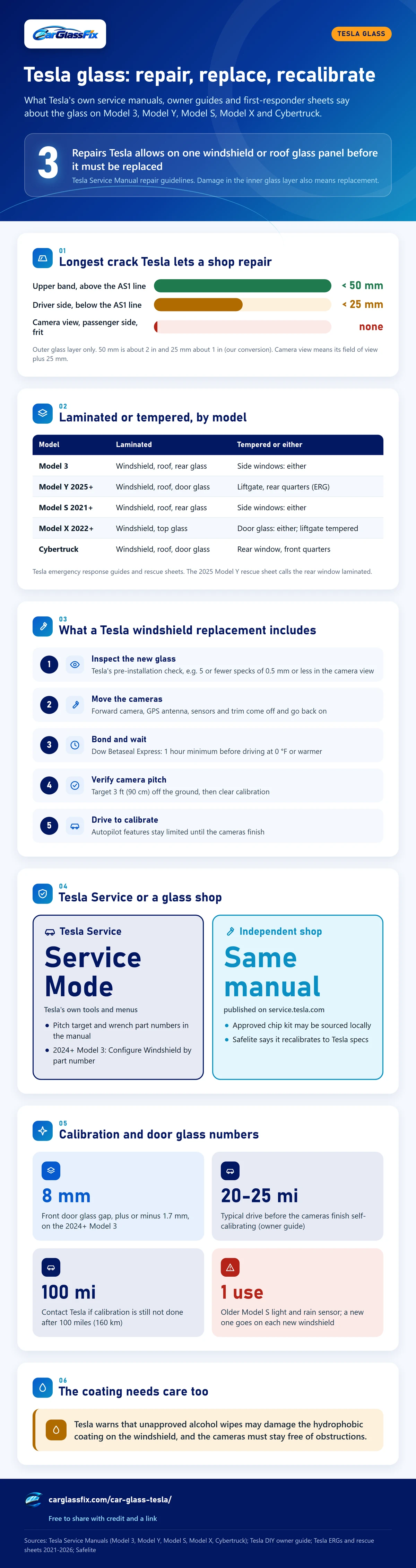
Tesla glass replacement follows Tesla’s public service manuals. Tesla repairs a chip only in the outer glass layer, away from the camera, the passenger side and the black border, and allows three repairs per panel. A new windshield needs camera pitch verification, a cleared calibration and usually 20 to 25 miles of driving.
How does Tesla glass replacement work?
Tesla glass replacement works like any bonded auto glass job, with extra steps for the cameras and sensors that sit on the windshield. Tesla publishes the procedures in its service manuals on service.tesla.com. The manuals cover the Model 3, Model Y, Model S, Model X and Cybertruck.
The windshield and the glass roof are bonded to the body with urethane. The door glass bolts to the window regulator. The windshield also carries the forward cameras, so Tesla adds a camera check and a calibration drive after every windshield job. The table sums up what Tesla’s documents say for each piece of glass.
| Glass | How it is fitted | What Tesla adds after replacement |
|---|---|---|
| Windshield | Urethane bond, cut out with a wire tool | Camera pitch verification, cleared calibration, calibration drive |
| Glass roof | Urethane bond, cut out the same way | Adhesive drive-away time; no camera step |
| Front and rear door glass | Bolted to the regulator clamps | Gap and flush check, window calibration |
| Rear quarter glass (2024+ Model 3) | Urethane bond; cannot be reused once removed | Tesla removed it from mobile service in 2026 |
Tesla lists the drive-away time for its usual adhesive, Dow Betaseal Express, as 1 hour minimum at 0 °F (-18 °C) or warmer. The manual also tells technicians to advise owners to avoid high speeds and speed bumps for 24 hours.
Can a Tesla windshield chip be repaired instead of replaced?
A Tesla windshield chip can be repaired when it is small, sits only in the outer glass layer and lies outside three no-repair areas. Tesla’s “Windshield and Roof Glass Repair and Replacement Guidelines” set the rules, and the same page appears in the manual for every model.
Where Tesla never repairs a windshield
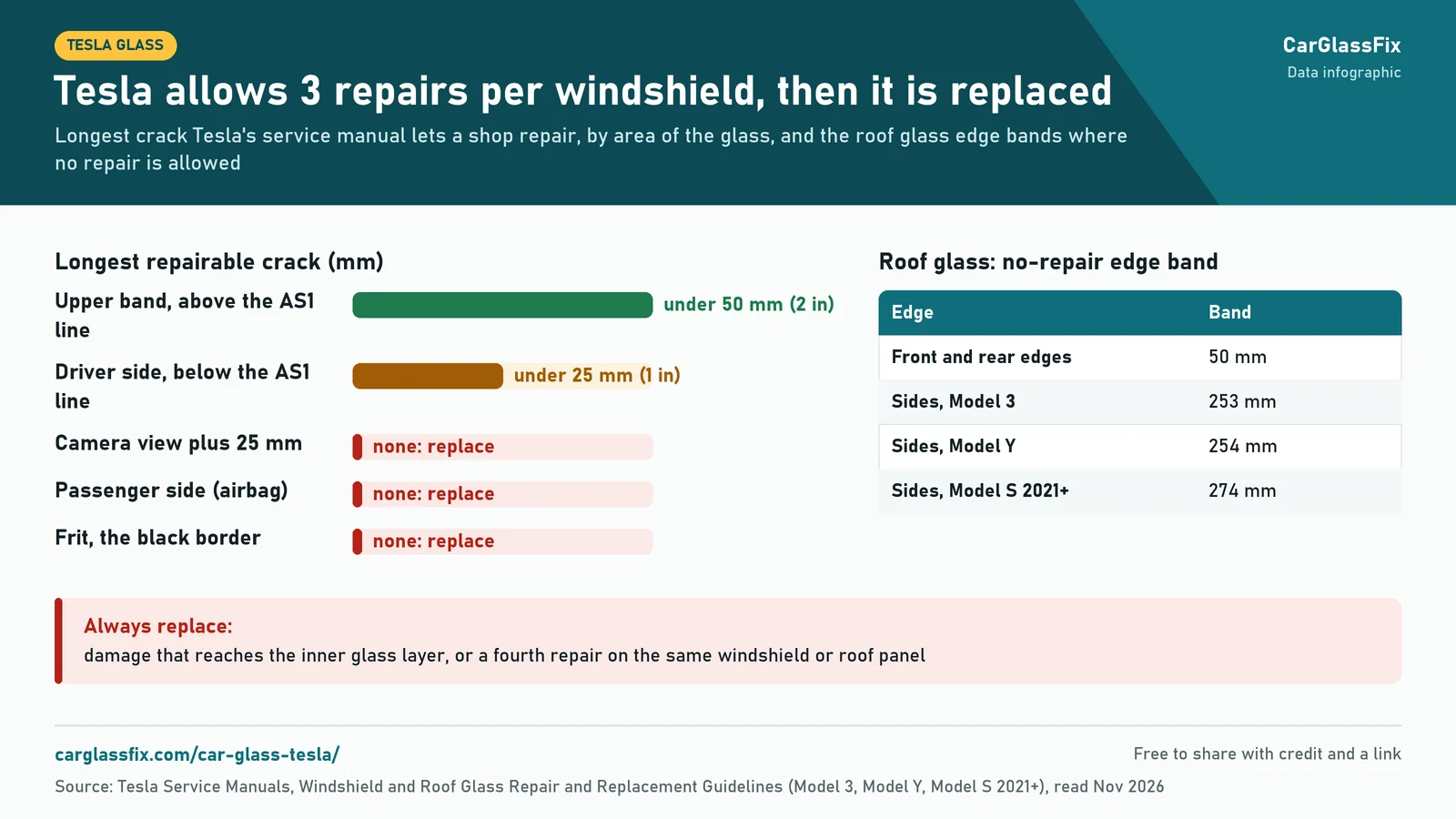
Tesla never repairs damage in the frit, in the camera view or on the passenger side. The frit is the painted black border. The camera zone is the camera’s field of view plus 25 mm (about 1 in) around it. Tesla bans passenger-side repairs because the front passenger airbag relies on that side of the windshield to position itself when it deploys. Damage in any of these areas means a new windshield.
Size limits in the repairable areas
Tesla’s size limits depend on the height of the damage. Between the upper border and the AS1 line, Tesla allows cracks shorter than 50 mm (about 2 in) and chips less than 50 mm wide. On the Model 3 and Model Y the AS1 line sits 145 mm below the upper border; the 2021+ Model S manual gives 155 mm. Below the AS1 line, on the driver side, Tesla allows rock chips, round damage up to 25 mm across and cracks shorter than 25 mm. For a star break, the technician adds the longest crack to the crack running the opposite way.
| Area of the windshield | What Tesla allows |
|---|---|
| Frit, camera view plus 25 mm, passenger side | No repair; replace |
| Upper band, down to the AS1 line | Cracks under 50 mm; chips under 50 mm wide |
| Driver side, below the AS1 line | Rock chips; round damage up to 25 mm; cracks under 25 mm |
| Any area, inner glass layer damaged | No repair; replace |
| Fourth repair on the same glass | No repair; replace |
How Tesla repairs a chip
Tesla repairs a chip with an approved resin kit, under set temperature conditions. In North America the approved kit is the Glasweld Essential Windshield Repair Kit, which Tesla says may be bought from Tesla or sourced locally. The procedure asks for the car out of direct sunlight and the glass between 60 and 85 °F (15 to 30 °C). The technician pulls a vacuum, injects resin and cures it with a UV light. Where local rules on windshield repair are stricter than Tesla’s, Tesla says to follow the local rules. The general rules for any car are in our guide to windshield repair vs. replacement.
Which Tesla glass is laminated and which is tempered?
Every current Tesla has a laminated windshield and laminated roof glass, and the side glass is laminated or tempered depending on model and window. Tesla states this in its emergency response guides and rescue sheets for firefighters. Laminated glass holds together when it breaks, while tempered glass crumbles into small pieces.
| Model (Tesla document) | Laminated | Tempered, or either |
|---|---|---|
| Model 3, 2024+ (rescue sheet) | Windshield, top glass, rear window | Side windows: tempered or laminated |
| Model Y, 2025+ (emergency response guide, Feb 2026) | Windshield, roof, moving door glass | Liftgate backlight and fixed rear quarter windows: tempered |
| Model S, 2021+ (emergency response guide) | Windshield, roof glass, rear liftgate glass | Side windows: tempered or laminated |
| Model X, 2022+ (rescue sheet) | Windshield, top glass | Door windows: tempered or laminated; liftgate and fixed rear quarter: tempered |
| Cybertruck, 2023+ (rescue sheet) | Windshield, roof, moving door glass | Rear window and front quarter windows: tempered |
Tesla’s own documents do not always agree. The 2025 Model Y rescue sheet calls the rear window laminated, while the 2025 Model Y emergency response guide calls the liftgate backlight tempered. A glass shop can confirm the type from the mark printed in the corner of each pane. The differences between the two glass types are covered in laminated glass vs tempered glass.
Acoustic glass
Acoustic glass is laminated glass with a sound-damping layer, and Tesla’s own pages on it could not be read for this guide. For the 2024 Model 3, Drive Tesla Canada reported acoustic glass on all four passenger windows. GoAuto in Australia reported that all glass is acoustic insulated. Safelite says Tesla windshields include acoustic layers, UV protection and heating elements. Ask the shop to quote the same glass type your car left the factory with.
What is on a Tesla windshield, and what does replacement involve?
A Tesla windshield carries the forward camera bracket, sensors and a heater connection, so replacement means moving those parts to the new glass. The Model 3 manual removes the forward facing triple camera, the GPS antenna and the windshield harness from the windshield bracket. It also disconnects a humidity and temperature sensor and the windshield heater connector. To see whether any car has a camera behind the glass, read how to tell if your windshield has a camera.
Some steps differ by model and year. On the 2024+ Model 3, the technician ends the job in Service Mode under Thermal, picks Configure Windshield and selects the part number of the new glass. When a new temperature and humidity sensor comes with the glass, Tesla says to reinstall or update the car’s firmware. On the older Model S, the light and rain sensor is a one-time use part, so a new one goes on each new windshield.
The Model 3 windshield procedure in Tesla’s service manual runs in this order.
Tesla windshield replacement steps (Model 3 service manual)
Inspect the new glass
Tesla’s pre-installation check limits flaws in the camera view to five specks of 0.5 mm or less; more, or larger ones, mean the part is replaced.
Remove interior parts
Cowl screen, sun visor bases, forward facing triple camera, GPS antenna and A-pillar trim come off.
Cut out the old glass
A wire tool (WRD Spider 3) cuts the urethane, and two people lift the windshield out.
Prime and bond
The flange is cleaned and primed, and a urethane bead about 8 mm wide and 13 mm high goes on the original path.
Set and refit
The glass is set to gap and flush, taped, and the camera, antenna, sensor and trim go back on.
Verify the camera
The technician runs forward camera pitch verification with Tesla’s calibration target.
Wait for the adhesive
No driving until the adhesive maker’s drive-away time has passed.
Tesla glass roof damage and replacement
Tesla’s glass roof follows the same repair rules as the windshield, with a wider no-repair band at the edges. Tesla allows no roof repair within 50 mm (about 2 in) of the front and rear edges. At the sides, the no-repair band is 253 mm on the Model 3, 254 mm on the Model Y and 274 mm on the 2021+ Model S, about 10 to 11 in. Inside those bands, cracks shorter than 50 mm and chips under 50 mm wide in the outer layer can be repaired.
The same limits apply as on the windshield. Damage in the inner layer means replacement. A fourth repair on one roof panel means replacement. Tesla’s emergency documents list the roof glass as laminated on the Model 3, Model Y, Model S and Cybertruck, and as laminated “top glass” on the Model X.
Replacing a fixed glass roof
Replacing a fixed glass roof is a bonded job like a windshield. On the Model 3 and Model Y the roof glass is cut out of its urethane with the same wire tool. Tesla specifies a larger urethane bead for the roof, about 12.5 mm wide and 20 mm high. The adhesive drive-away rules and the 24-hour advice are the same. The 2012 to 2020 Model S service manual also covers a sliding panoramic roof, with its own calibrate procedure. For the general method, see how to replace laminated sunroof glass.
Frameless door glass and side windows
Tesla door glass has no full frame around it, so after replacement it must be set to exact gap and flush values against the body. The 2024+ Model 3 manual gives a front door glass gap of 8 mm plus or minus 1.7 mm and a flush of 0 mm plus or minus 1.7 mm. The glass bolts to the regulator clamps at 9.5 Nm (7.0 lb-ft).
Cleaning out the door
A broken door window can leave splinters on the parts that hold the new glass. Tesla tells technicians to inspect the regulator clamps for glass splinters and clean them, because “Debris and splinters may damage or shatter the new door glass.” After the new glass is in, the technician runs a window calibration from Service Mode under Windows.
Window calibration
Owners can calibrate a window too. The wording of Tesla’s guide shows that the glass normally drops a little when a door opens. Tesla’s Model 3 owner guide says to do it when a window touches the bright molding, fails to open or close properly, or goes down more than normal when the door opens. The steps are to close the door, sit in the driver seat, raise the window until it stalls, lower it until it stalls and raise it again. If the problem stays after a couple of tries, Tesla says to check the puddle lights and then contact Tesla.
Bonded side glass
Some side glass is bonded rather than bolted. On the 2024+ Model 3, the rear quarter glass cannot be reinstalled once removed. Tesla removed it from mobile service in May 2026, citing urethane curing time and environmental concerns.
Camera calibration after Tesla glass work
A new Tesla windshield needs a camera pitch check and a cleared calibration, and then the cameras calibrate themselves while the car is driven. Tesla’s service manual says camera calibration data must be cleared any time an external camera’s position has changed, so the risk of unwanted Autopilot behavior is reduced. The broader process for all cars is explained in ADAS calibration and windshield replacement.
What the technician does
The technician verifies the forward camera’s pitch with a Tesla calibration target in front of the car. The target’s lower edge is set 3 ft (90 cm) off the ground, with at least 3.5 ft (106 cm) of clear space ahead of the bumper. On HW3 and HW4 cars the check runs in Service Mode, and a special wrench adjusts the camera if it is out of range. On the Model S, the manual warns that Autopilot features might be reduced if camera pitch is not verified. Cars with first-generation Autopilot use a target calibration or a drive cycle calibration instead.
What the owner sees
The owner finishes calibration by driving. Tesla’s owner guide says calibration typically completes after 20 to 25 miles (32 to 40 km), and the touchscreen shows a progress bar. It finishes faster on a straight multi-lane highway with clear lane lines. Tesla says to contact Tesla only if calibration is still not done after 100 miles (160 km). Until it finishes, an attempt to use Autopilot shows a message that manual driving is required while the camera calibrates. On the Cybertruck, the manual says driver-assist functions are completely unavailable during this drive.
Clearing calibration yourself
Owners can restart calibration from the touchscreen. Tesla’s owner guide says that if a camera has shifted, for example after a windshield replacement, touch Controls, then Service, then Camera Calibration, then Clear Calibration. Tesla adds that this may not resolve all camera and sensor concerns. Shops that calibrate on the spot use either a target or a road drive, as compared in static vs dynamic ADAS calibration.
Tesla Service vs independent glass shops
Tesla Service and independent glass shops can both replace Tesla glass, and Tesla publishes the procedures and names repair kits that can be sourced locally. Tesla’s service manuals are open to read on service.tesla.com. The windshield procedure names Tesla’s tools by part number, including the Camera Calibration Target and a pitch adjustment wrench. Some steps run in Tesla’s Service Mode or its Toolbox 3 diagnostic software.
Safelite, a national US glass chain, says its technicians repair or replace tens of thousands of Tesla windshields each year. Safelite says a growing number of its shops can recalibrate the forward camera, usually in the same appointment. It also says it recalibrates according to Tesla’s specifications, by a static or dynamic process depending on the model.
| Question to ask | Why it matters (Tesla’s documents) |
|---|---|
| Will you inspect the new glass before fitting it? | Tesla requires a pre-installation inspection of every new windshield, roof, door and fixed glass part |
| Will you verify camera pitch and clear the calibration? | Tesla requires both after a windshield replacement |
| Which adhesive, and what drive-away time? | Tesla says not to drive until the adhesive maker’s minimum time has passed |
| Will the repair stay outside Tesla’s no-repair zones? | Tesla allows no repair in the camera view, passenger side or frit |
| Does the glass match the factory type? | Tesla uses laminated and tempered glass in different positions by model |
How insurance pays for the job depends on your policy, not on the shop. See does insurance cover windshield replacement before you book.
Tint and coatings on Tesla glass
Tesla’s documents read for this guide set two glass-care rules: keep the camera area clear, and protect the windshield’s hydrophobic coating. Tesla’s owner guide says to keep all cameras clean and free of obstructions before each drive. If a camera is blocked, the touchscreen shows a message and some features may be unavailable. Controls, then Service, then Camera Visibility shows a summary of poor camera visibility on the last drive.
The hydrophobic coating
The coating rule comes from the service manual. Tesla warns that unapproved IPA (isopropyl alcohol) wipes may damage the hydrophobic coating on the windshield. Tesla’s technicians clean the inside of the glass in front of the camera with specified lens wipes and check for haze with an LED flashlight.
Tint film and the AS-1 line
No Tesla page read here sets a rule for aftermarket tint film. The federal rule still applies to every car. FMVSS 205 requires the glazing needed for driving visibility to pass at least 70% of light, and NHTSA says darker areas must sit above the AS-1 line. Tesla uses the same AS1 line to divide its windshield repair zones. State limits for windshield strips are in is it illegal to have tint on windshield.
Frequently asked questions
Do I have to replace my Tesla windshield at Tesla?
No Tesla document read for this guide requires it. Tesla publishes its glass procedures on service.tesla.com, and Safelite says it replaces Tesla windshields and recalibrates the cameras to Tesla’s specifications.
Can a crack in a Tesla windshield be repaired?
Tesla allows a repair only for short cracks in the outer layer: under 50 mm (about 2 in) above the AS1 line and under 25 mm (about 1 in) below it on the driver side. Cracks in the camera view, on the passenger side, in the black border or in the inner layer mean replacement.
How long does Tesla camera calibration take after a new windshield?
Tesla’s owner guide says calibration typically completes after 20 to 25 miles of driving, faster on a multi-lane highway with clear lane lines. Contact Tesla if it is not done after 100 miles (160 km).
Is the Tesla glass roof covered by the same repair rules?
Yes. Tesla applies the same 50 mm crack and chip limits and the three-repair maximum to roof glass, but allows no repair within 50 mm of the front and rear edges or within about 10 to 11 in of the sides.
Can window tint affect my Tesla’s cameras?
Tesla says the cameras must be clean and free of obstructions, and a blocked camera can switch features off. Read does windshield tint interfere with sensors before you add film near the camera.
Sources
- Tesla Model 3 Service Manual: Windshield and Roof Glass Repair and Replacement Guidelines (also Model Y, Model S 2021+ and Cybertruck versions; checked 2026-11-06)
- Tesla Service Manual: Windshield and Roof Glass Chip Repair (updated 2026-03-23)
- Tesla Service Manual: Pre-Installation Glass Inspection
- Tesla Model 3 Service Manual: Windshield (2nd Generation or Later Autopilot) (Remove and Replace) (dated 2026-08-09)
- Tesla Model 3 2024+ Service Manual: Windshield (LHD) (Remove and Replace)
- Tesla Model S Service Manual: Windshield (Remove and Replace)
- Tesla Cybertruck Service Manual: Windshield Assembly (Remove and Replace)
- Tesla Service Manual: Vehicle Cameras and Autopilot
- Tesla Service Manual: Camera – Forward Facing (Pitch Verification) (dated 2026-08-09)
- Tesla Model S Service Manual: Target Calibration – Forward Facing Camera
- Tesla Model 3 Service Manual: Glass – Roof – Fixed (Remove and Replace)
- Tesla Model 3 2024+ Service Manual: Glass – Door – Front – LH (Remove and Replace)
- Tesla Model 3 2024+ Service Manual: Glass – Body – Rear Quarter – LH (Remove and Replace)
- Tesla Service Manual: Clean Forward Camera View (Precision Cleaning of Inboard Glass) (updated 2026-10-29)
- Tesla Model 3 Do It Yourself guide: Cameras and Calibrating Cameras
- Tesla Model 3 Do It Yourself guide: Calibrating Windows
- Tesla 2024 Model 3 Rescue Sheet (TESLA-2024M3-001, version 04)
- Tesla 2025 Model Y Emergency Response Guide (February 2026) and 2025 Model Y Rescue Sheet
- Tesla Model S Emergency Response Guide (2021 to present)
- Tesla 2022 Model X Rescue Sheet
- Tesla Cybertruck Rescue Sheet (TESLA-2023CA-001, version 02)
- Safelite: Tesla windshield replacement and Tesla ADAS recalibration
- Safelite: What Tesla Owners Need to Know About Windshield Replacement (Feb 17, 2026)
- Drive Tesla Canada: 2024 Tesla Model 3 review
- GoAuto: Updated Tesla Model 3 (2023-11-27)
- NHTSA interpretation 11-000697 on FMVSS 205 and the AS-1 line (May 10, 2011)
Similar Posts