How to Clean Windshield Molding Without Damaging the Rubber
Senior Automotive Glass Diagnostic Specialist & Master Technician at CarGlassFix · AGSC Master Certified Auto Glass Technician, NGA Certified Installer, I-CAR Automotive Safety Specialist · 12+ Years in Automotive Glazing, Windshield Structural Bonding, ADAS Camera Calibration & Precision Chip Restoration
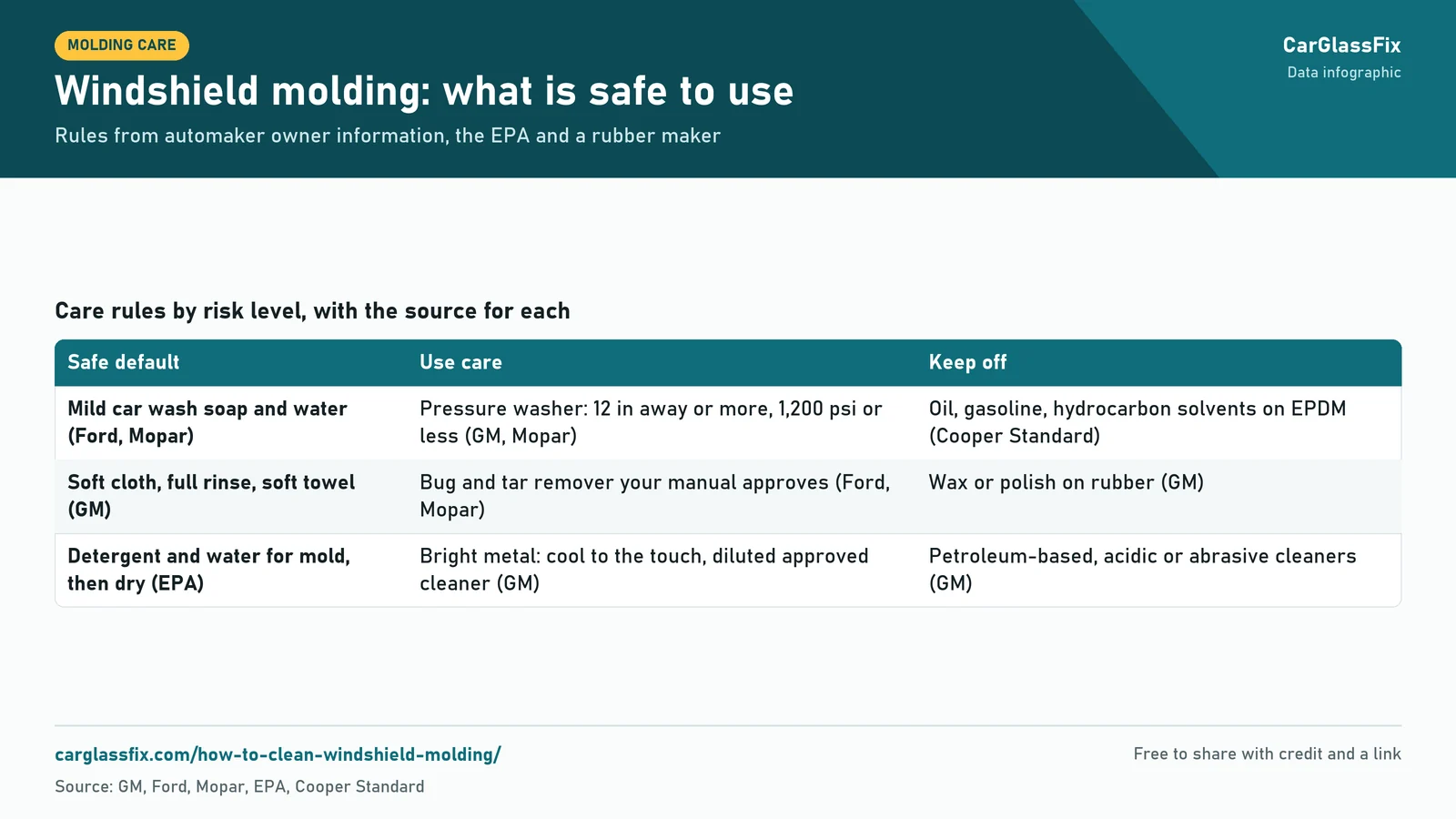
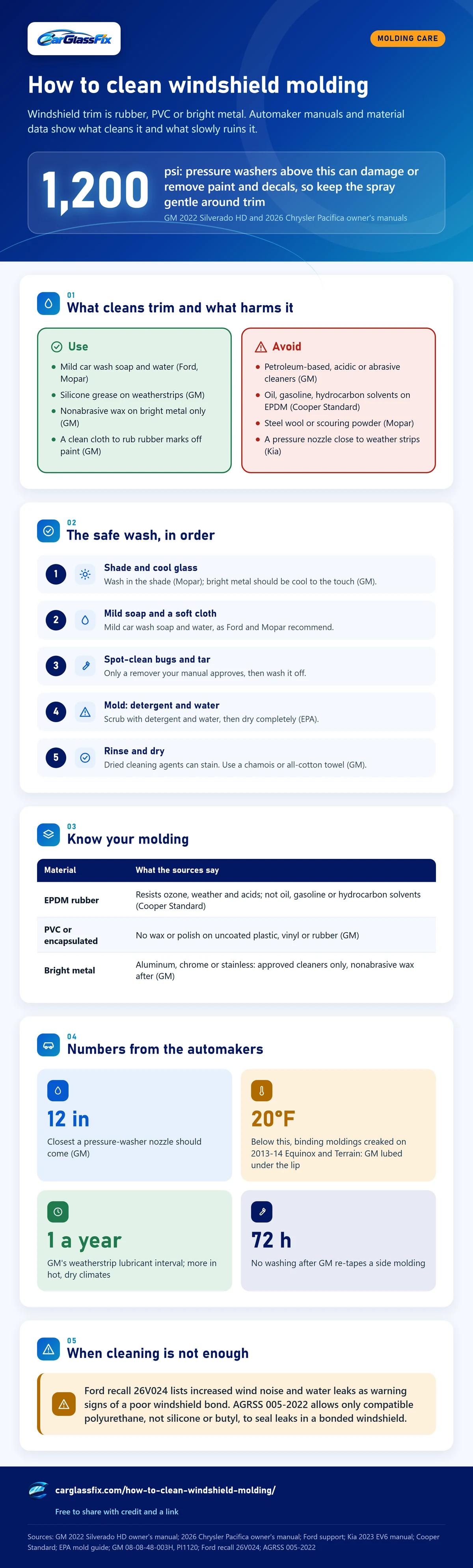
Clean windshield molding with mild car wash soap, water and a soft cloth, then rinse and dry it. Ford and Mopar both name mild soap for vehicle washing. Keep petroleum solvents, abrasives, wax and close pressure-washer spray off the rubber. EPDM, the common weatherstrip rubber, resists weather well but handles hydrocarbon solvents poorly.
What to clean windshield molding with
Mild car wash soap and water is the safest cleaner for windshield molding. Ford recommends its own products or a mild soap and water solution for most of the vehicle. Mopar’s 2026 Chrysler Pacifica manual names a mild car wash soap and says to rinse completely. Neither automaker writes a separate rule for windshield molding, so the general exterior rule applies.
A soft sponge or cloth does the work. GM’s rubber guidance for wiper blades uses a lint-free cloth with washer fluid or a mild detergent, and Ford also allows washer fluid or water. Those instructions cover wiper rubber, but they show the mild end of what automakers accept on rubber parts. Your owner’s manual overrides all of this, and Ford tells owners to check its Vehicle Care section before buying a product. Glass needs its own products and methods, covered in the guide to what not to use to clean car windows.
Check which molding material you have
Windshield molding is usually rubber, plastic or bright metal, and each one has its own limit. Sika’s glass-installer manual refers to PVC and EPDM encapsulated parts and moldings. GM describes bright metal moldings as aluminum, chrome or stainless steel.
| Molding type | What it looks like | Main care limit | Source |
|---|---|---|---|
| EPDM rubber | Flexible black strip | Keep oil, gasoline and hydrocarbon solvents off it | Cooper Standard; Parker |
| PVC or plastic trim | Firmer black strip or trim piece | No chemical solvents or strong detergents | Kia, for plastic parts |
| Bright metal | Aluminum, chrome or stainless steel strip | Clean only when cool, with an approved and correctly diluted cleaner | GM, 2022 Silverado HD manual |
Look and feel are only a rough guide to the material. A parts diagram for your model or a dealer parts desk can confirm it. If you cannot tell, treat the molding as rubber and use mild soap and water, the gentlest option in this guide.
How to clean windshield molding step by step
The method below is a hand wash built from automaker washing guidance, since no automaker publishes a molding-specific procedure. Mopar says to wash in the shade. Griot’s Garage says to work on cool glass and to leave glass for last. GM says to rinse before and after washing, because cleaning agents left to dry can stain. GM also says to dry with a soft, clean chamois or an all-cotton towel to avoid scratches and water spots. Do not lift the molding edge to reach underneath, because some moldings are held by tape, clips or urethane.
How to clean windshield molding
Park in the shade
Let the glass and molding cool. Bright metal should be cool to the touch before any cleaner goes on it.
Rinse off loose grit
Use a gentle hose stream so grit does not grind against the rubber or the glass.
Wash with mild soap
Wipe along the molding with a soft sponge or cloth and a mild car wash soap solution.
Work the edge gently
Follow the seam where the molding meets the glass. Do not pry or lift the edge.
Rinse fully
Rinse all soap off the molding, glass and nearby paint before it dries.
Dry with a soft towel
Dry the molding, then check for cracks, gaps or loose sections.
Clean the glass last
Use glass cleaner on the windshield after the molding is done, and keep trim products off the glass.
What damages windshield molding and seals
Petroleum solvents, abrasives, wax and close high-pressure spray are the main documented risks to molding and seals. Cooper Standard rates EPDM as not recommended for oil, gasoline and hydrocarbon solvents. Parker’s O-ring handbook lists mineral oil products as not compatible with EPDM. GM warns that petroleum-based, acidic or abrasive cleaners can damage paint, metal or plastic parts.
| Risk | What the source says | Source |
|---|---|---|
| Adhesive remover gel | Rubber “can break down” if the gel sits | Goo Gone |
| Pressure washer | Stay 12 in (30 cm) away; over 1,200 psi can damage or remove paint and decals | GM; Mopar gives the same psi figure |
| Nozzle near rubber | Keep the tip away from weather strips | Kia, 2023 EV6 manual |
| Wax and polish | Do not apply to rubber, vinyl or uncoated plastic | GM |
| Abrasive materials | No steel wool or scouring powder on metal and painted surfaces | Mopar |
GM and Mopar tie the pressure figures to paint and decals, while Kia’s rule is the one written for rubber. Kia also warns that high-pressure water may leak through windows and body gaps.
How to remove mold, tar and sap from molding
Mold comes off molding with detergent and water, and tar or sap needs the gentlest remover your manual approves. The EPA says to scrub mold off hard surfaces with detergent and water and dry them completely. The EPA also says absorbent or porous materials may have to be thrown away, a rule that can apply to sponge-type seals. Use a soft brush, then rinse and dry fully. Stains that remain after a full wash may need a new molding if the appearance matters.
Vinegar is common advice in search results, and the page on how to clean windshield with vinegar covers its use on glass. No automaker document found for this guide recommends it for molding, and the EPA method does not need it. Ford names its Bug and Tar Remover for tar or grease on plastic parts, and Mopar names its own for tar and insect deposits. Apply any remover to a cloth, keep contact short, then wash the area with soap and water. For deposits on the glass itself, see how to clean tree sap off windshield and how to remove adhesive from windshield.
Protecting molding from sun and drying out
Parking under cover is the simplest protection, and a rubber-safe protectant is optional. GM says to keep the vehicle garaged or covered whenever possible, although that line is written for paint. Cooper Standard says EPDM is well known for ozone, weathering and aging resistance, so EPDM molding starts with good sun resistance.
No automaker document found for this guide tells owners to dress windshield molding on a schedule. GM does tell owners to lubricate door-type weatherstrips once a year, more often in hot, dry climates, and silicone grease is its named option. Parker lists EPDM as resistant to silicone oil and grease. A related guide covers car window glass seal rubber care on side windows.
If you use a UV protectant, follow its label and confirm it is rated for rubber. Apply protectant to a cloth and keep it off the glass. GM says a buildup of wash and wax treatments may cause wiper streaking. Sika says silicone residue left on glass by factory lamination can harm adhesion, so a shop should know about any dressing used near the edge.
When cleaning is not enough
Cleaning cannot fix molding that is loose, torn, cracked or leaking. If an edge lifts, taps or whistles at speed, the guide on how to fix loose windshield molding explains the clip, tape and urethane fixes automakers use. If the strip is split, brittle or missing pieces, see how to replace windshield molding, including the cases where the glass has to come out.
Water inside the car is a separate problem from dirty trim. Ford’s 2026 Explorer recall named increased wind noise and water leaks as warning signs of badly applied windshield urethane, so have both checked by a glass shop. The steps for how to fix a leaking windshield start with finding the source. Do not run silicone sealant along the molding as a fix. AGRSS 005-2022 allows only compatible polyurethane for sealing leaks in a polyurethane retention system, with no silicone or butyl.
Fresh repairs need time before washing. GM’s bulletin for re-taped side moldings calls for at least 72 hours without washing or heavy contact. After a new windshield, follow the installer’s instructions and the guide on how to care for your car after glass replacement.
Frequently asked questions
Can I use WD-40 on windshield molding?
It is safer to skip it unless the product label says it is safe for rubber. Cooper Standard says EPDM rubber is not recommended for oil and hydrocarbon solvents, so check the formula first. GM’s named option for weatherstrips is weatherstrip lubricant or silicone grease.
Can I use a Magic Eraser on windshield molding?
No maker document found for this guide approves it for rubber molding. GM warns against abrasive cleaning agents on plastic parts, so start with soap and a soft cloth. Video guides that use one are not an automaker’s advice.
Is glass cleaner safe on windshield molding?
GM says to clean the outside of the windshield with glass cleaner, but it gives no rule for the molding. Clean the molding with mild soap first and wipe any glass cleaner off the rubber. Kia warns against strong detergents on plastic parts.
Why does my molding leave black marks on the cloth?
Black rub-off can come from dirt or from worn rubber, and no automaker document found here gives a test for which one it is. GM says black marks from rubber on paint can be removed by rubbing with a clean cloth. Replace the molding if the surface is crumbling or cracked.
How often should I clean windshield molding?
No automaker sets an interval for windshield molding, so clean it whenever you wash the car. Mopar simply says to wash the vehicle regularly. Inspect the edge for gaps or cracks at the same time.
Sources
- Ford: How do I clean my Ford? (checked October 31, 2026)
- Chevrolet 2022 Silverado 2500 HD/3500 HD owner’s manual, Exterior Care
- Chrysler 2026 Pacifica owner’s manual, Bodywork and Exterior Care
- Kia 2023 EV6 owner’s manual, Exterior care
- Cooper Standard: Rubber Properties
- Parker O-Ring Handbook ORD 5700
- 3M Adhesive Remover technical data sheet (2005)
- Goo Gone Automotive Spray Gel FAQ
- Sika AGR Technician Training Manual (2009 revision, hosted copy)
- EPA: What are the basic mold cleanup steps? (January 2025 snapshot)
- Griot’s Garage: glass how-to
- GM bulletin 08-08-48-003H (NHTSA copy)
- Ford recall 26V024, NHTSA Part 573 report
- ANSI/AGSC/AGRSS 005-2022 (checked October 22, 2026)
Similar Posts