Auto Glass Tools: What Technicians Use and Why
Senior Automotive Glass Diagnostic Specialist & Master Technician at CarGlassFix · AGSC Master Certified Auto Glass Technician, NGA Certified Installer, I-CAR Automotive Safety Specialist · 12+ Years in Automotive Glazing, Windshield Structural Bonding, ADAS Camera Calibration & Precision Chip Restoration
Auto glass tools fall into four groups. Removal tools (cold knives, wire or cord cut-out systems, power cut-out tools) cut the urethane bond. Prep tools (scrapers, razor blades, primer daubers) clean the pinchweld. Install tools (urethane guns, vacuum cups, setting devices) place the glass. Chip repair uses a bridge, resin injector and UV curing light.
As an Amazon Associate, CarGlassFix earns from qualifying purchases. Amazon links on this page open a product search on Amazon. They are not products we tested.
What auto glass tools are
Auto glass tools are the hand tools, power tools and handling equipment used to remove, install and repair bonded vehicle glass. A modern windshield is held by a urethane adhesive bead, so most replacement tools exist to cut that bead, clean the bonding surface and lay a new bead. Equalizer, a US auto glass tool maker founded in 1987, sorts its catalog into protection, removal, preparation, installation, specialty tools and glass repair. That order matches the job itself. The standards set the rules for how the tools are used. AGRSS 005-2022, the US auto glass replacement standard, requires installers to follow the adhesive maker’s written instructions. ROLAGS 002-2022, the US windshield repair standard, lists the equipment a repair system should include. Neither standard names a brand of tool. Each tool group below is tied to the document that calls for it. For the whole replacement sequence, read how to install a windshield by yourself.
Removal tools: cold knife, wire and suction cups
Removal tools cut through the cured urethane between the glass and the body flange, called the pinchweld. Equalizer groups them as cord and wire tools, reciprocating and oscillating power tools, cold knives, long knives and pinchweld protection.
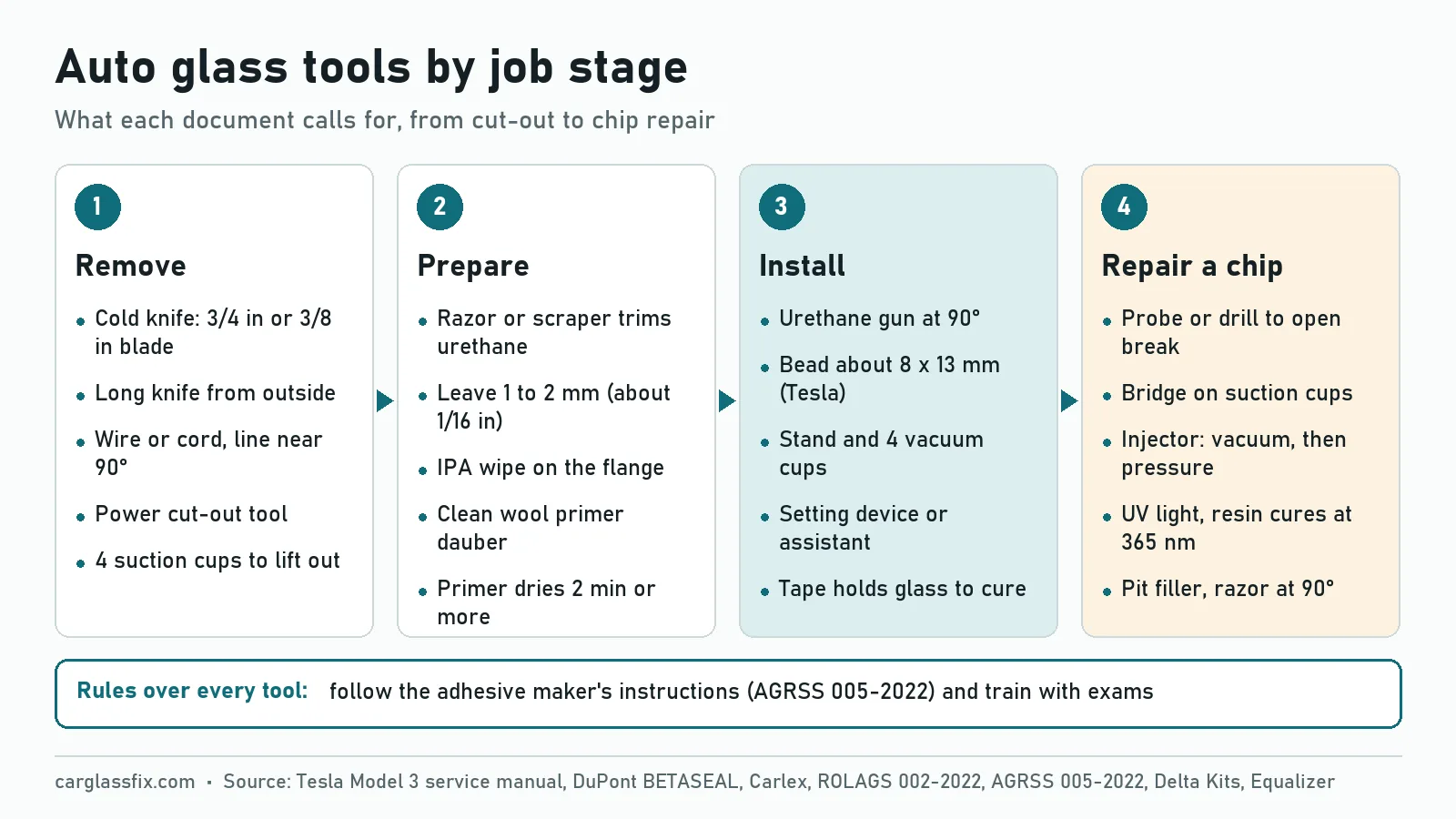
A cold knife is a hand blade on a pull handle. Equalizer sells cold knife blades in 3/4 in and 3/8 in widths, including coated blades meant to protect paint. A long knife reaches the bead from outside the car. Wire and cord systems pass a line through the urethane and pull it around the glass. Tesla’s Model 3 manual uses the WRD Spider 3 kit: a starter tool pushes the line through the urethane, an anchor holds the outside end, and a winder on the inside pulls the line at about 90 degrees. Toyota’s Corolla procedure uses piano wire tied to wooden blocks. DuPont leaves the choice open and tells installers to cut the glass out “using your preferred method.” After the cut, Tesla attaches four suction cups and lifts the glass out with an assistant. Carlex, which supplies Ford glass, warns installers to avoid scratching the pinchweld during removal.
Preparation tools: scrapers, razors and primer daubers
Preparation tools trim the old urethane and apply primer so the new bead can bond. The old urethane is not scraped down to bare metal. DuPont’s BETASEAL instructions leave a 1 to 2 mm base of original urethane on the pinchweld. Carlex calls this the full cut method and describes a level bed about 1/16 in thick. Tesla’s Model 3 procedure trims the flange with a razor blade and then cleans the urethane path with an isopropyl alcohol wipe. Equalizer’s preparation range covers scrapers, razor blades, utility knives and body preparation tools.
The primer applicator is a small but specified tool. DuPont applies BETAPRIME 5504G primer with a clean wool dauber in one even wet coat. The dauber must be clean and unused, and it must never go back into the bottle after it touched the car. Tesla lets primer dry at least 2 minutes before the bead goes on. AGRSS defines primer as an agent designed by the adhesive maker, so the primer and the urethane come from one system.
Installation tools: urethane guns, vacuum cups and setting devices
Installation tools lay the urethane bead and lower the new glass onto it in the right position. The urethane gun, also called a caulking gun, pushes adhesive from a cartridge or sausage pack. Equalizer lists manual guns with 18 to 1 and 26 to 1 thrust ratios plus cordless guns. Sika applies its SikaTack ELITE urethane with its own PowerCure dispenser. DuPont tells installers to hold the applicator at 90 degrees to the glass and lay a continuous V-shaped bead with no gaps.
| Install step | Tool | What the document says | Source |
|---|---|---|---|
| Dry fit | Setting blocks or locating pins, tape or grease pencil | Center the glass side to side and mark its position | Carlex (Ford/Lincoln) |
| Hold the glass | Support stand, four suction cups | New windshield on a stand, cups on the left and right sides | Tesla Model 3 |
| Lay the bead | Urethane gun at 90 degrees | Triangular bead about 8 mm wide and 13 mm high | Tesla Model 3; DuPont |
| Set the glass | Vacuum cups, assistant or setting device | Check gap and flush before fully seating | Tesla Model 3 |
| Hold while curing | Masking tape | Tape the glass to the body until the urethane cures | Tesla Model 3 |
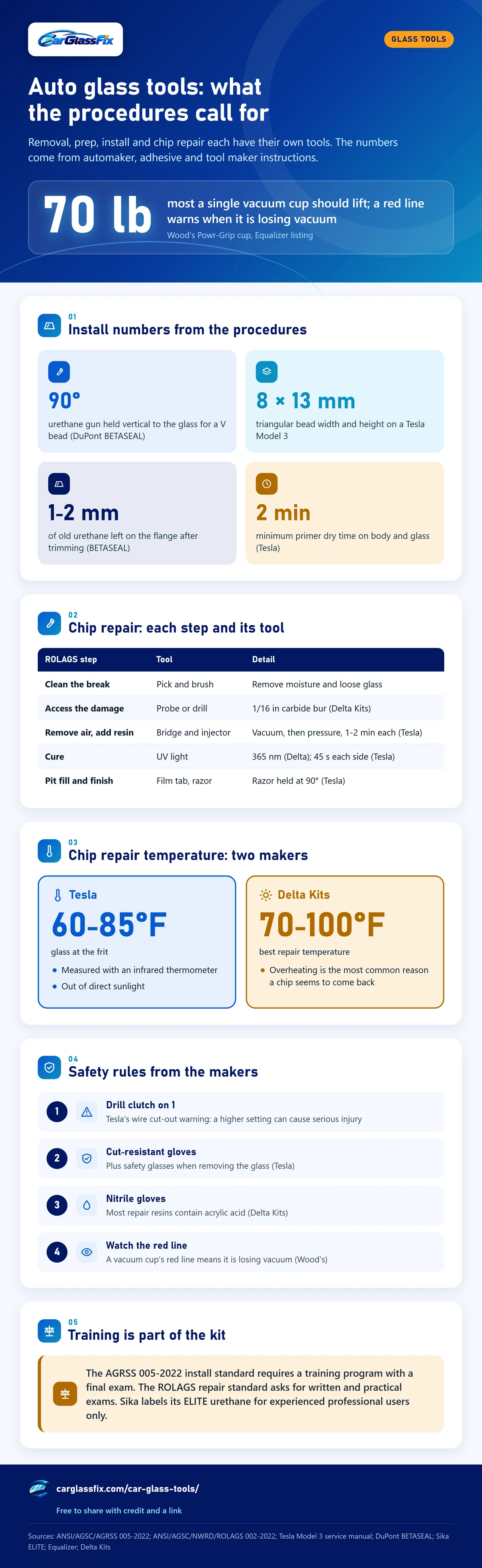
Vacuum cups carry a load limit. The Wood’s cup sold by Equalizer has a red line that warns when vacuum is being lost, and the listing says not to lift more than 70 lb per cup. Setting devices replace the second person. Equalizer describes its one-person setting tool as acting as “the other person” for a windshield or back glass. Bead size changes by vehicle: Carlex gives a 1/2 to 5/8 in high bead for Ford and Lincoln.
Chip repair tools: bridge, injector and UV light
Chip repair tools fill a break with resin instead of replacing the glass. ROLAGS 002-2022, section 11, says a repair system should include equipment to remove moisture and dirt, access the damage, remove or displace air and inject resin, and fill the pit and cure the resin. Section 8 adds that the technician accesses the damage “through probing or drilling.” Delta Kits, a repair system maker, lists a mini rotary tool, a 1/16 in collet and a tapered carbide bur for drilling the ends of long cracks. Tesla’s Model 3 service manual shows how a professional kit is used on a chip:
How a chip repair kit is used (Tesla Model 3 service manual)
Check the glass temperature
Move the car out of direct sunlight and confirm 60 to 85°F (15 to 30°C) at the black frit with an infrared thermometer.
Clean the break
Remove debris with the kit’s pick and brush, and place a mirror inside the glass to see the impact point.
Mount the bridge
Set the mounting stand over the chip with suction sealant on its cups and the lower leg at 6 o’clock.
Load the injector
Put 4 to 6 drops of resin in the injector, fit the seal and press it to the glass plus 1 to 2 clicks.
Cycle vacuum and pressure
Pull vacuum for 1 to 2 minutes, then push resin for 1 to 2 minutes, and repeat until no air remains.
Cure the resin
Hold the curing light 1.5 to 2 in from the repair for 45 seconds on each side while the injector stays under pressure.
Fill and finish the pit
Cure pit filler under a film tab for 1 minute, then scrape flush with a razor blade at 90 degrees.
Delta Kits says almost all windshield repair resins cure at 365 nm, so a UV lamp’s color does not matter. Delta Kits recommends 70 to 100°F for repairs, which is warmer than Tesla’s range. To remove leftover resin, see how to clean the windshield after resin repair.
DIY vs pro auto glass tools
Professional and DIY tools do the same jobs, and the standards put the main difference in the person using them. AGRSS 005-2022, section 9.1, requires replacement technicians to complete a comprehensive training program with a final exam and ongoing education, including adhesive-maker-specific training. ROLAGS 002-2022, section 10, requires repair technicians to pass a written and a practical exam. Sika labels its ELITE urethane “suitable for experienced professional users only.” AGRSS, section 5.7, also requires calibration equipment made for the vehicle’s driver assistance system when the automaker requires calibration. A home tool kit does not include that equipment. See how sensors are calibrated after windshield replacement.
Consumer chip kits copy the repair steps with simpler parts. The Rain-X windshield repair kit, for example, holds resin, a repair device, curing strips and a razor blade. Our windshield repair kit guide lists more. Whether that gives a lasting result is covered in do windshield repair kits really work. Kit types are compared in windshield chip repair kits compared by type. Side windows use different tools and steps, covered in how to replace a car side glass panel.
Safety gear and tool risks
Auto glass tools carry their own injury and damage risks, and the makers’ documents name the protective gear. Tesla’s Model 3 procedure requires cut-resistant gloves and safety glasses when trimming urethane with a razor blade. In June 2026 Tesla added a warning to set the drill clutch to 1 before driving the Spider wire tool. Tesla says that skipping this step “may result in serious injury.” DuPont lists nitrile chemical-resistant gloves, safety glasses and a work apron for urethane work. Delta Kits recommends nitrile gloves for chip repair because most repair resins contain acrylic acid. Tesla calls for latex gloves during resin injection.
Tools can also damage the car. Tesla uses a guard to keep the cutting line off the dash pad and the VIN plate. I-CAR warns that alignment pins on reused glass can be damaged or cut off during removal. Delta Kits names overheating the glass and too much injector or bridge pressure as causes of a chip that reappears later. After any install, the car must wait for the adhesive maker’s drive-away time. See how to care for your car after glass replacement.
Frequently asked questions
What tools are needed to replace a car windshield?
A replacement uses a cut-out tool (cold knife, long knife, wire or cord system, or power tool), vacuum cups, a razor or scraper, a primer dauber, a urethane gun and masking tape. Tesla’s Model 3 procedure adds a support stand and an assistant. The adhesive maker’s instructions decide the primer, bead shape and drive-away time.
What is a cold knife used for in auto glass?
A cold knife is a hand blade pulled through the urethane bead to free the windshield from the pinchweld. Equalizer sells cold knife blades in 3/4 in and 3/8 in widths, some coated to protect paint.
What tool do technicians use to repair windshield chips?
Technicians use a bridge or mounting stand, a resin injector that cycles vacuum and pressure, and a UV curing light. ROLAGS 002-2022 also calls for a way to access the break by probing or drilling and a pit filling step.
Can I do a windshield chip repair myself?
Consumer kits exist and follow the same inject-and-cure steps with simpler parts. ROLAGS still requires trained technicians and limits repairs by size and location. Check how big a windshield crack can be repaired before you buy a kit.
Do I need special tools to install a windshield?
Yes. A urethane-set windshield needs a cut-out tool, vacuum cups, primer and urethane from one adhesive system and a urethane gun. Cars with a forward camera also need calibration equipment that meets AGRSS section 5.7.
Sources
- ANSI/AGSC/AGRSS 005-2022, Automotive Glass Replacement Safety Standard, sections 3.19, 5.4, 5.7, 6.5 and 9.1 (checked 27 October 2026)
- ANSI/AGSC/NWRD/ROLAGS 002-2022, Repair of Laminated Automotive Glass Standard, sections 8, 10 and 11 (checked 27 October 2026)
- Tesla Model 3 Service Manual: Windshield (Remove and Replace)
- Tesla Model 3 Service Manual: Windshield and Roof Glass Chip Repair
- DuPont BETASEAL primerless-to-glass adhesives, windshield installation instructions (2019)
- Carlex: Ford/Lincoln Carlite general guidelines for urethane-set glass
- Sika USA: SikaTack ELITE product data sheet
- Toyota Corolla (E120) windshield replacement procedure (repair manual mirror)
- I-CAR Repairability Technical Support: stationary glass considerations
- Equalizer: glass removal tools, caulking guns, vacuum cups and setting devices
- Rain-X windshield repair kit directions
- Delta Kits knowledge base: resin injectors, drilling long cracks and UV lights for windshield repair; chip reappearing after repair; repair temperature; gloves

Similar Posts