Wipes for Inside Car Windows: What Is Safe on Tint and Glass
Senior Automotive Glass Diagnostic Specialist & Master Technician at CarGlassFix · AGSC Master Certified Auto Glass Technician, NGA Certified Installer, I-CAR Automotive Safety Specialist · 12+ Years in Automotive Glazing, Windshield Structural Bonding, ADAS Camera Calibration & Precision Chip Restoration
Glass wipes are fine for light film on the inside of car windows when the label says ammonia-free and safe on tint. They suit quick touch-ups better than heavy haze. Armor All and Stoner sell ammonia-free automotive wipes, but film makers differ on alcohol, so check your film’s care sheet first.
Are glass wipes good for car windows?
Glass wipes are good for car windows when the job is light and the wipe is made for automotive glass. Armor All says its wipes are designed for interior and exterior car glass. Stoner says its Invisible Glass formula removes fingerprints, smoke haze, plasticizer film and dust. Both statements come from sellers. No independent lab test comparing wipes with other methods was found for this guide.
The right answer depends on the wipe type. The word “wipe” covers products with very different jobs, and shopping results mix them together. The table sorts the common types by what their makers and film makers have published.
| Wipe type | Inside bare glass | Inside tint film |
|---|---|---|
| Automotive glass wipe, ammonia-free | Made for this use, per Armor All and Stoner | Sold as tint safe; check your film maker’s sheet |
| Household glass wipe | Windex recommends its Ammonia-Free Glass Cleaner for car windows and names no wipe | Avoid unless the label rules out ammonia and the film maker agrees |
| Interior protectant wipe | Wrong product; Armor All warns its protectant spray may smear glass | Wrong product |
| Alcohol wipe | No automaker guidance found | Ceramic Pro bans alcohol; Avery Dennison allows alcohol-based cleaner |
| Reusable microfiber, damp | Nissan pairs glass cleaner with a soft cloth | XPEL’s first choice, slightly damp with water |
What is inside automotive glass wipes
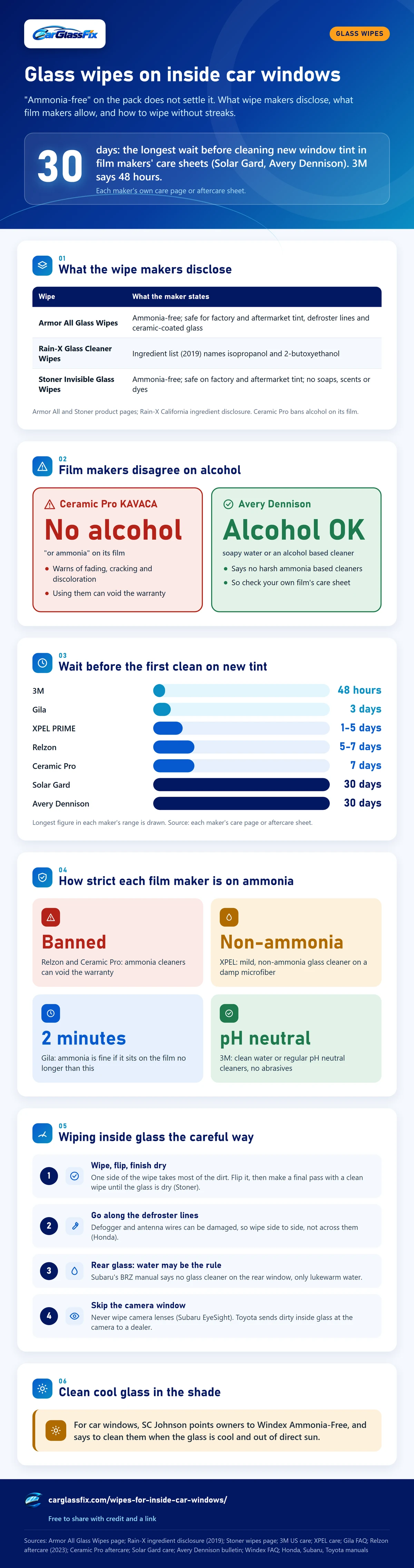
Automotive glass wipes carry a liquid cleaner on a sheet, and makers disclose different amounts about it. Rain-X publishes a California ingredient disclosure, while Armor All and Stoner describe their formulas on product pages. A disclosure is not a full recipe, so a missing ingredient does not prove the product is free of it.
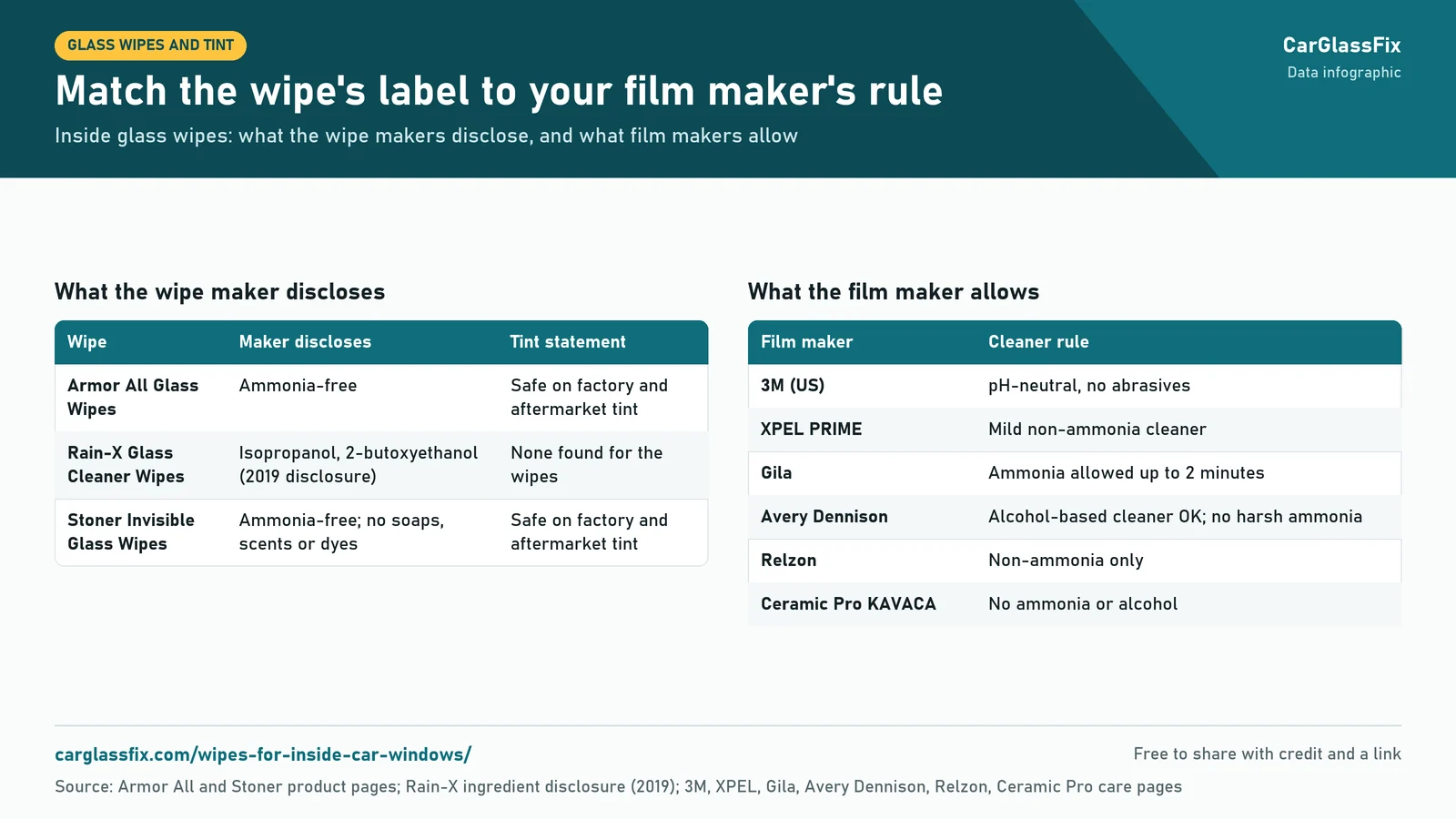
| Wipe | What the maker discloses | Maker’s tint statement |
|---|---|---|
| Armor All Glass Wipes | Ammonia-free | Safe on factory tint and aftermarket tint film; check the tint maker’s guidelines |
| Rain-X Glass Cleaner Wipes | Isopropanol and 2-butoxyethanol (California ingredient disclosure, September 2019) | None found for the wipes |
| Stoner Invisible Glass Wipes | Ammonia-free; no soaps, scents or dyes | Safe on factory and aftermarket tint |
Rain-X’s disclosure names no ammonia. Armor All and Stoner state outright that their wipes are ammonia-free. Formulas change, so read the current label for the exact pack you hold.
Can you use household glass wipes on car windows and tint?
Household glass wipes can clean plain car glass, but they are the riskier choice on tint because the pack may not say what the wipe contains. Windex’s own FAQ steers car owners to its Ammonia-Free Glass Cleaner, and it describes Windex Original Wipes for smaller surfaces. This guide could not confirm the current wipe formula, so treat an unlabeled household wipe as a possible ammonia product. The car glass cleaner vs Windex page covers that comparison.
Film makers give the final word on film, and they do not agree. None of the care pages read for this guide mentions pre-moistened wipes by name, so the rules below apply to the cleaner in the wipe. Warranty terms can depend on them: Relzon says ammonia cleaners void its warranty, and Ceramic Pro says the same of ammonia or alcohol products.
| Film maker | Wait before first cleaning | Cleaner rule |
|---|---|---|
| 3M (US) | At least 48 hours | pH-neutral cleaners without abrasives |
| XPEL PRIME | About 1 to 5 days | Damp microfiber; mild non-ammonia cleaner if needed |
| Gila | At least 3 days | Ammonia cleaner allowed for up to two minutes on the film |
| Relzon | 5 to 7 days | Non-ammonia only |
| Ceramic Pro KAVACA | At least 7 days | No ammonia or alcohol |
| Solar Gard (US) | 30 days | Most glass cleaners, or dish soap and water |
| Avery Dennison | 30 days | Soapy water or alcohol-based cleaner; no harsh ammonia |
The full routine for film is on the how to clean tinted car windows page.
Do glass cleaning wipes work as well as spray and towel?
Glass cleaning wipes work for small areas, but a spray and two towels give you more control over drying and film removal. The makers’ own directions show the limit. Armor All tells users to repeat until streak-free. Stoner says one side of the wipe collects most of the dirt, then you flip it, then you make a final pass with a clean wipe until the glass is dry.
A towel method separates cleaning from drying. Tesla’s service procedure for the outside of the glass at the forward camera applies glass cleaner to a microfiber towel and dries with a second towel. Nissan’s manual says glass cleaner and a soft cloth will remove the film that forms after parking in hot sun. Stoner notes that haze may need more than one application.
A practical split follows from those directions. Keep wipes for fingerprints and a quick pass, and use spray and towels for a full windshield. The how to clean windshield without streaks guide covers the towel method. Some film makers also warn about the sheet itself: Solar Gard says some paper towels are coarse enough to scratch film, and it warns against materials contaminated with dirt. Use a fresh wipe once one picks up grit.
Wipes, residue and fog on the inside of the glass
A wipe can remove thin inside film, but streaks can stay behind, which is why Armor All’s directions say to repeat. Thermo Fisher describes the inside film as compounds that outgas from interior plastics and textiles in heat, then condense on the cooler windshield. That film can limit and refract light. Stoner says its formula has no soaps, scents or dyes. Stoner sells that formula, so read its statement as a claim.
If streaks appear after a wipe, follow with a dry towel or a clean second pass. Interior protectant wipes are the wrong tool here. Armor All says not to use its protectant on or near glass because it may cause smearing.
Fog is a separate problem from film. Fog is moisture condensing on cold glass, and a cleaning wipe does not change cabin humidity, so see why is my car window fogging up inside for causes. Thick or returning film belongs on the haze on the inside of a windshield page.
Defroster lines, antennas and camera areas
Defroster lines need the gentlest treatment, and the cautious choice on some cars is water and no wipe at all. Subaru’s 2013 BRZ manual says not to use glass cleaner on the rear window because it may damage the heater wires, and it specifies a cloth with lukewarm water. A glass wipe is a glass cleaner in sheet form, so that rule reasonably covers wipes too. Ram’s 2022 manual allows a soft cloth and mild washing solution, wiping parallel to the heating elements. Honda’s 2012 Accord Coupe manual warns that the defogger and antenna wires can be damaged, and it says to wipe side to side.
Automaker wording varies by model, so read your own manual. The method itself is on the how to clean rear windshield inside page.
The camera area has its own rule. Toyota’s 2026 RAV4 Plug-in Hybrid manual says not to let glass cleaner touch the front camera lens, and it sends owners to a dealer if the inside glass at the camera is dirty. Subaru says never to wipe EyeSight lenses. Stop the wipe short of the housing. The windshield camera identification guide shows how to tell if your car has one. Armor All lists infotainment screens as “use with caution” and points to the vehicle maker’s guidance.
Storing glass wipes in a hot car
Glass wipes sit in the glove box in many cars, so check the storage line on your pack before you leave it in a hot car.
Close the lid after each use, as Stoner directs, so the remaining wipes stay moist. See what not to use to clean car windows for the wider list of products to avoid.
Frequently asked questions
Can I use Windex to clean the inside of my car windows?
Windex recommends its Ammonia-Free Glass Cleaner for car windows, including tinted ones. It also advises cleaning when the glass is cool and out of direct sun.
Are Armor All glass wipes safe for tinted windows?
Armor All says the wipes are ammonia-free and safe on factory tint and aftermarket tint film. It also says to check the tint maker’s guidelines for a specific film.
What is the best thing to wipe car windows with on the inside?
Nissan’s manual pairs glass cleaner with a soft cloth for the film on inside glass. On tinted windows, XPEL’s first choice is a microfiber towel slightly dampened with water.
How long after tinting can I use wipes on the windows?
Follow your film maker’s wait, which ranges from at least 48 hours at 3M to 30 days at Solar Gard and Avery Dennison. Ask your installer which film you have.
Do glass wipes stop windows from fogging?
A cleaning wipe removes film and does not change cabin humidity, so it does not clear the cause of fog. Clearing fog depends on airflow and moisture. See how to defog a windshield quickly.
Sources
- Armor All, Glass Wipes product page and FAQ (checked 2026-11-02)
- Rain-X Glass Cleaner Wipes, California ingredient disclosure (September 2019) (checked 2026-11-12)
- Stoner Car Care, Invisible Glass Wipes (Canister) (checked 2026-11-02)
- Stoner Car Care, How to Clean Windshield Haze
- Windex FAQ (checked 2026-11-02)
- Armor All Air Freshening Protectant (checked 2026-11-12)
- 3M, Product Care Guide for Window Tint (checked 2026-11-02)
- XPEL, product care (checked 2026-11-02)
- Gila, automotive window tint FAQ (checked 2026-11-02)
- Relzon, aftercare 2023
- Ceramic Pro KAVACA, window film warranty and aftercare
- Solar Gard, care instructions (checked 2026-11-02)
- Avery Dennison, solar film maintenance sheet
- Thermo Fisher, Understanding a Fog Testing System, ANTCFOGTEST0311
- Tesla Model Y service manual, Clean Forward Camera View
- Nissan Juke 2025 manual, cleaning glass
- Subaru 2013 BRZ owner’s manual (manual copy)
- Ram 2500/3500 2022 owner’s manual
- Honda 2012 Accord Coupe owner’s manual (manual copy)
- Toyota 2026 RAV4 PHEV owner’s manual excerpt
- Subaru EyeSight manual supplement

Similar Posts